
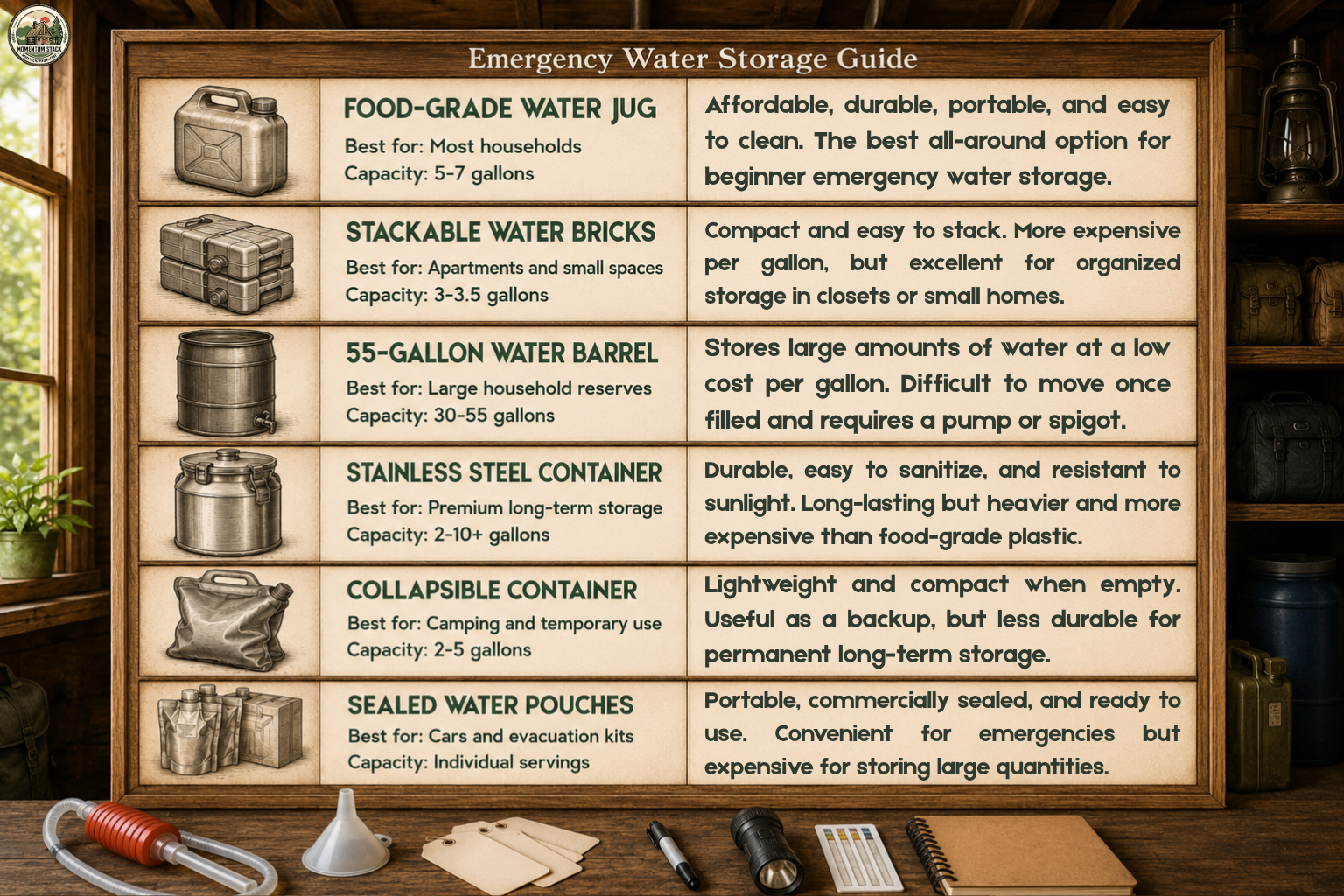

Choosing the right container is just as important as storing enough water. Here’s how to compare the safest, most durable, and most practical options for every household.
Best Water Storage Containers for Emergency Preparedness (Compared)
When preparing for emergencies, most people focus on how much water they need—but far fewer think about where that water will actually be stored.
The truth is, even the cleanest drinking water can become unsafe if it’s kept in the wrong type of container. Thin disposable bottles crack over time, reused milk jugs can harbor bacteria, and containers made from non-food-grade plastics may leach unwanted chemicals or develop leaks during long-term storage.
A well-chosen water storage container protects your emergency water supply from contamination, light, temperature changes, and physical damage. It should also be practical enough for your home, easy to clean, and simple to rotate as part of your preparedness routine.
Whether you’re building a basic emergency kit for short-term outages or creating a larger household water reserve, selecting the right container can save money, reduce maintenance, and make your emergency plan much easier to manage.
In this guide, you’ll learn:
- What makes a water storage container safe for drinking water
- The pros and cons of the most common container types
- Which options work best for apartments, families, and long-term storage
- Common buying mistakes to avoid
- How to clean and maintain containers for years of reliable use
New to emergency water planning? Before choosing container sizes, read our guide on How Much Water Should You Store for Emergencies? to calculate the right amount for your household.
Why Choosing the Right Water Storage Container Matters
Not all water containers are designed for long-term drinking water storage.
While many containers look similar on the outside, differences in materials, sealing quality, UV protection, and durability can dramatically affect how well your water stays clean over time.
Choosing the right container provides benefits far beyond simple convenience.
It Keeps Drinking Water Safe
Water naturally absorbs odors, flavors, and contaminants from its surroundings.
Containers made specifically for drinking water use food-grade materials that won’t transfer unwanted chemicals into the stored water under normal household conditions. High-quality containers also feature tight-fitting lids that help prevent dust, insects, and bacteria from entering during storage.
By contrast, containers not intended for food use may contain materials that aren’t suitable for long-term contact with drinking water.
It Reduces the Risk of Leaks
Emergency water often sits untouched for months.
Poor-quality containers may develop cracks, weak seams, or damaged caps that slowly leak over time. Even a small leak can waste dozens of gallons before anyone notices.
Durable containers built for long-term storage are designed to withstand years of normal household use without failing, making them a far more reliable investment.
It Makes Water Easier to Use During Emergencies
Large water supplies are only useful if you can actually access them.
For example:
- A 55-gallon barrel stores a large amount of water efficiently but becomes nearly impossible to move once filled.
- A 5- to 7-gallon container is much easier to carry but requires more individual containers.
- Stackable water bricks maximize storage in tight spaces while remaining manageable for one person.
The best option depends not only on storage capacity but also on who may need to lift or transport the water during an emergency.
It Helps Maximize Storage Space
Space is one of the biggest challenges for emergency preparedness.
Some households have garages, basements, or utility rooms with plenty of room for large barrels. Others may only have a closet, pantry, or apartment corner available.
Choosing containers designed for efficient stacking or vertical storage allows you to build a larger water reserve without sacrificing valuable living space.
It Simplifies Long-Term Maintenance
Every emergency water supply requires occasional inspection and rotation.
Containers with wide openings are easier to sanitize.
Containers with smooth interiors are easier to rinse.
Clearly labeled containers make it simple to track fill dates and rotation schedules.
These small details reduce maintenance over the years while helping ensure your stored water remains safe when you actually need it.
What Makes a Good Emergency Water Storage Container?
With so many products available, it’s easy to assume that any sturdy plastic container will work. In reality, only a few features truly matter for safe, long-term water storage.
Here are the characteristics worth prioritizing before making a purchase.
Food-Grade Materials
The first requirement is simple:
Your container should be specifically manufactured for storing food or drinking water.
Most reliable emergency water containers are made from food-grade high-density polyethylene (HDPE), commonly identified by the recycling symbol #2. This material is widely used because it is durable, resistant to impact, and appropriate for long-term food and water contact.
Avoid containers that were originally used for chemicals or non-food products, even if they appear clean. Residues can remain inside and contaminate future water supplies.
Opaque or Dark-Colored Plastic
Sunlight encourages algae growth and gradually degrades many plastics.
That’s why most emergency water containers are blue or another opaque color rather than completely transparent.
Storing water in containers that block light helps maintain water quality, especially if the containers are kept in garages, sheds, or utility rooms where some natural light may be present.
Even with opaque containers, storing them in a cool, dark location provides the best protection.
Leak-proof caps
A quality cap is just as important as the container itself.
Look for containers with:
- Heavy-duty threaded lids
- Durable sealing gaskets
- Secure locking mechanisms
- Replacement cap availability
A reliable seal helps keep contaminants out while preventing slow leaks that may go unnoticed for months.
Strong Carrying Handles
Water is surprisingly heavy.
Each gallon weighs approximately 8.34 pounds (3.8 kg), meaning even a modest 5-gallon container weighs more than 40 pounds (18 kg) when full.
Comfortable, reinforced handles make lifting, transporting, and pouring much easier during emergencies.
If multiple family members may need to move stored water, portability becomes an especially important consideration.
Stackable Design
Many modern emergency containers are designed to stack securely.
Stackable containers offer several advantages:
- Better use of limited floor space
- More organized storage
- Reduced risk of tipping
- Easier inventory management
For apartments and smaller homes, stackable systems often provide the most efficient balance between storage capacity and accessibility.
Easy cleaning
Every container should be easy to inspect and sanitize.
Wide-mouth openings allow you to:
- Reach interior surfaces
- Rinse thoroughly
- Remove sediment
- Dry completely before refilling
Containers with narrow openings may be harder to clean properly, especially after years of repeated use.
Compatibility With Pumps and Spigots
Large containers become much more convenient when paired with the right accessories.
Many emergency water containers are compatible with:
- Manual siphon pumps
- Gravity-fed spigots
- Dispensing faucets
- Replacement vent caps
These accessories make everyday rotation and emergency use significantly easier, particularly for large-capacity containers that are difficult to lift once filled.
Comparison Table: Best Water Storage Containers
The following table compares the most common options available for home emergency water storage.
| Container Type | Typical Capacity | Best For | Main Advantages | Possible Drawbacks |
|---|---|---|---|---|
| HDPE Water Jugs | 5–7 gallons | Most households | Affordable, durable, easy to carry | Require multiple containers for large reserves |
| Stackable Water Bricks | 3–3.5 gallons | Small homes and apartments | Excellent space efficiency, modular storage | Higher cost per gallon |
| Military-Style Water Cans | 5–6 gallons | Heavy-duty outdoor use | Extremely rugged, secure sealing | Heavier and more expensive |
| Stainless Steel Containers | 2–10+ gallons | Long-term durability | No plastic taste, very long lifespan | Higher initial cost |
| Emergency Water Barrels | 30–55 gallons | Large household reserves | Lowest cost per gallon stored | Difficult to move when full |
| Collapsible Water Containers | 2–5 gallons | Camping and evacuation kits | Lightweight and compact | Less suitable for permanent storage |
1. HDPE Water Jugs
For most homeowners, food-grade HDPE water jugs offer the best balance of affordability, durability, and ease of use.
They are widely recommended because they’re specifically designed for drinking water storage and are available in capacities that one person can still manage safely. Most hold between 5 and 7 gallons, making them practical for routine rotation while providing a meaningful emergency supply.
Unlike disposable bottles or improvised containers, quality HDPE jugs are built for repeated filling, long-term storage, and years of regular use. Their sturdy construction resists cracking, while integrated handles make lifting and pouring much easier.
For many households, these containers provide an excellent starting point before expanding to larger systems such as stackable water bricks or 55-gallon barrels in the next sections.
2. Stackable Water Bricks
If storage space is limited, stackable water bricks are one of the smartest solutions available.
Unlike traditional water jugs, these rectangular containers are designed to stack securely on top of one another, allowing you to build a larger emergency water supply while using minimal floor space.
They’re especially popular among apartment dwellers, condo owners, and anyone without a garage or basement.
Advantages
- Excellent use of vertical space
- Easy to organize on shelves or closets
- Individual containers remain lightweight
- Modular system that’s easy to expand over time
- Less risk of losing an entire water supply if one container is damaged
Drawbacks
- Higher cost per gallon than standard jugs
- More individual containers to clean and rotate
- Usually require purchasing multiple units for larger reserves
Best for:
- Apartments
- Small homes
- Emergency closets
- Families gradually building preparedness supplies
3. Military-Style Water Cans
Military-style water cans are designed for rugged environments where durability matters more than convenience.
Inspired by traditional military jerry cans, these containers typically feature thick food-grade plastic, reinforced walls, and extremely secure caps that resist leaks during transportation.
Although heavier and more expensive than standard water jugs, they’re built to handle rough handling, vehicle transport, and repeated use.
Advantages
- Extremely durable
- Excellent sealing system
- Comfortable carrying handles
- Resistant to impacts
- Suitable for off-grid use
Drawbacks
- Higher price
- Heavier when empty
- Bulkier than stackable systems
Best for:
- Off-grid properties
- Bug-out supplies
- Vehicle emergency kits
- Rural homes
4. Stainless Steel Water Containers
For homeowners looking for maximum longevity, stainless steel containers are an excellent premium option.
Unlike plastic, stainless steel doesn’t absorb odors or flavors over time and offers exceptional resistance to wear.
Many people also prefer stainless steel because it eliminates concerns about long-term plastic exposure, although food-grade HDPE remains widely accepted for emergency water storage.
Advantages
- Extremely long lifespan
- No plastic taste
- Resistant to UV damage
- Easy to sanitize
- Attractive appearance
Drawbacks
- Significantly more expensive
- Heavier than plastic
- Fewer large-capacity options
Best for:
- Daily drinking water
- Small household reserves
- Long-term investment
5. Large Emergency Water Barrels
When maximizing storage capacity is the priority, few options are more efficient than 55-gallon water barrels.
A single barrel stores enough water for many days while offering one of the lowest costs per gallon of any storage solution.
However, large barrels require planning.
A filled 55-gallon barrel weighs well over 450 pounds (200 kg), making it effectively impossible to move without specialized equipment.
For this reason, always place large barrels in their permanent location before filling them.
Advantages
- Lowest storage cost per gallon
- Ideal for large families
- Minimal maintenance once positioned
- Excellent for garage or basement storage
Drawbacks
- Extremely heavy when full
- Requires transfer pumps or spigots
- Not practical for evacuation
Best for:
- Long-term household reserves
- Dedicated emergency storage areas
- Homes with garages or basements
6. Collapsible Water Containers
Collapsible containers aren’t designed for years of permanent storage, but they serve an important role in emergency preparedness.
When empty, they fold flat and occupy very little space, making them ideal for evacuation kits, camping equipment, or temporary water collection.
Many preparedness experts keep several collapsible containers alongside their primary water storage system.
Advantages
- Lightweight
- Compact
- Affordable
- Excellent backup solution
Drawbacks
- Less durable
- Shorter lifespan
- Not recommended for permanent long-term storage
Best for:
- Camping
- Travel
- Bug-out bags
- Temporary emergencies
Plastic vs. Stainless Steel Water Containers
Both materials have legitimate advantages.
Choosing the right one depends on your budget, storage goals, and household needs.
| Feature | Food-Grade HDPE | Stainless Steel |
|---|---|---|
| Cost | ★★★★★ Affordable | ★★ Expensive |
| Durability | ★★★★☆ | ★★★★★ |
| Weight | Lightweight | Heavy |
| UV Resistance | Good | Excellent |
| Taste Retention | Very Good | Excellent |
| Cleaning | Easy | Easy |
| Large Sizes Available | Yes | Limited |
| Best Overall Value | ✅ Yes | Premium Choice |
Which should you choose?
For most households, food-grade HDPE containers provide the best balance of safety, affordability, and practicality.
Stainless steel becomes a worthwhile upgrade if you’re willing to pay more for maximum longevity and prefer avoiding plastic whenever possible.
Common Mistakes When Buying Water Containers
Even experienced homeowners occasionally make purchasing mistakes that reduce the effectiveness of their emergency water supply.
Avoid these common problems.
Reusing Milk Jugs
Milk containers are made for short-term use.
They become difficult to sanitize completely and can break down over time, increasing the risk of contamination and leaks.
Buying Non-Food-Grade Containers
Not every plastic bucket or storage container is designed for drinking water.
Always verify that the manufacturer specifically labels the container as food grade.
Choosing Containers That Are Too Large
Many people assume bigger is always better.
In reality, a container that’s too heavy to lift becomes difficult to rotate, clean, or use during an emergency.
A combination of smaller containers often works better than relying entirely on massive barrels.
Ignoring Available Storage Space
Buying several large containers without planning where they’ll fit can create clutter and reduce accessibility.
Measure your storage area before purchasing.
Forgetting Accessories
Large containers often require additional equipment, including:
- Manual pumps
- Dispensing spigots
- Funnels
- Waterproof labels
- Permanent markers
Buying these items at the same time simplifies future maintenance.
How to Clean Water Storage Containers
Before filling any new or reused container, clean and sanitize it thoroughly.
Step 1
Wash the interior with warm water and mild dish soap.
Step 2
Prepare a sanitizing solution using unscented household bleach diluted according to public health guidance.
Step 3
Pour the solution into the container.
Shake gently to coat every interior surface.
Step 4
Allow the solution to remain inside for several minutes.
Step 5
Drain completely.
Rinse if recommended by the bleach manufacturer or applicable guidance.
Step 6
Fill immediately with safe drinking water.
Seal tightly.
Clearly label the fill date.
For a complete walkthrough, including water treatment and rotation schedules, read How to Store Water Long Term.
How to Store Water Containers Properly
The best container still needs the right storage environment.
Follow these simple practices:
- Store containers in a cool location.
- Keep them out of direct sunlight.
- Protect them from freezing temperatures.
- Avoid storing near gasoline, pesticides, paint, or strong chemicals.
- Inspect containers several times each year.
- Rotate water according to your household maintenance schedule.
- Record fill dates on waterproof labels.
Small habits like these help ensure your emergency water remains dependable for years.
Conclusion
Emergency water storage isn’t just about quantity—it’s about reliability.
The right container protects your water from contamination, makes routine maintenance easier, and ensures your household has safe drinking water when normal supplies are interrupted.
For most families, food-grade HDPE water jugs offer the best combination of affordability, durability, and convenience.
If space is limited, stackable water bricks make excellent use of every square foot. Households with larger preparedness goals may benefit from adding water barrels, while stainless steel containers provide exceptional longevity for those willing to invest more.
Whatever option you choose, remember that the best emergency water container is the one you’ll maintain properly, inspect regularly, and have ready when you need it most.
Preparedness isn’t about buying the most expensive equipment—it’s about building a system that works for your home.
Frequently Asked Questions
What is the best container for storing emergency water?
Food-grade HDPE containers are the best choice for most households because they’re durable, affordable, easy to clean, and specifically designed for drinking water storage.
Are plastic water containers safe?
Yes. Containers made from food-grade HDPE (#2) and intended for drinking water are widely used for long-term emergency water storage when used according to the manufacturer’s instructions.
Can I reuse milk jugs?
No.
Milk residue is difficult to remove completely, and the thin plastic isn’t designed for long-term reuse.
Are stainless steel water containers better?
Stainless steel is extremely durable and long-lasting but costs significantly more than food-grade plastic. Both are excellent options when properly maintained.
How often should I replace emergency water containers?
High-quality food-grade containers can last for many years if protected from excessive heat, sunlight, and physical damage. Replace any container that develops cracks, leaks, or damaged seals.
Should I buy one large barrel or several smaller containers?
For most households, a combination works best. Smaller containers are easier to move and rotate, while larger barrels provide economical long-term storage.
Can water storage containers be stacked?
Many containers are specifically designed for stacking, but always follow the manufacturer’s recommendations to prevent damage or instability.
Emergency Water Container Buying Checklist
✅ Food-grade material
✅ Tight leak-proof lid
✅ Opaque or UV-resistant
✅ Comfortable carrying handles
✅ Easy to clean
✅ Fits available storage space
✅ Compatible with pumps or spigots
✅ Appropriate size for household members
✅ Durable construction
✅ Clearly labeled with fill date