
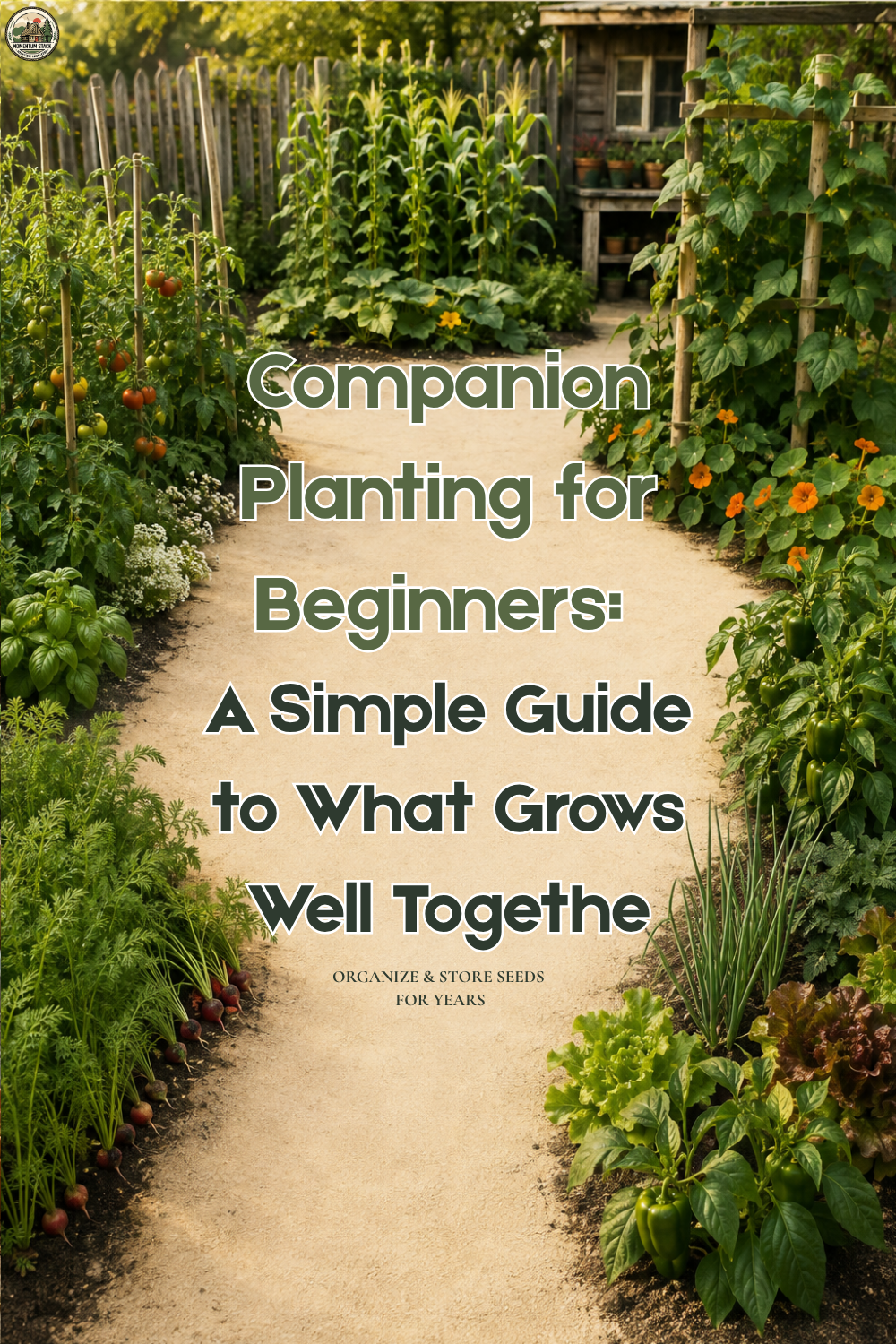

Walk through enough gardens and you will hear all kinds of companion planting advice.
Put basil beside tomatoes. Keep beans away from onions. Ring the whole garden with marigolds and the pests will pack their bags.
Some of that advice is useful. Some of it has been repeated so many times that nobody remembers where it came from. And some of it works in one garden but falls flat in another.
Here is the simple way to look at it:
Companion planting means arranging different plants so they can share a bed without making life harder for one another—and, when possible, so one plant provides a useful service for the other.
That service might be shade, ground cover, a living trellis, flowers for beneficial insects, or simply a different root shape that uses another part of the soil.
You do not need a giant chart or a perfect memory. You need to understand what each plant will look like when it is fully grown.
If this is your first garden, begin with a few of the easiest vegetables for beginners and try one or two combinations from this guide.
A small experiment you can observe is worth more than twenty “perfect pairings” squeezed into one crowded bed.
What Is Companion Planting?
Companion planting is the practice of growing two or more types of plants near one another because their growth habits work well together.
The neighbors do not always “feed” or “protect” each other directly. Often, the benefit is much more ordinary—and much more believable.
One plant may:
- Shade the soil around a crop that dislikes summer heat.
- Cover open ground and slow down weeds.
- Grow upward while another plant spreads along the ground.
- Flower early or for a long season, feeding pollinators and beneficial insects.
- Mature quickly and leave the bed before a slower crop needs the space.
- Make a vegetable patch more diverse, which can make it harder for certain pests to find a solid row of their favorite food.
Think of it as arranging a small neighborhood.
You want every resident to have enough sun, water, root room, and moving air. If two plants compete for all four, calling them “companions” will not rescue the arrangement.
Does Companion Planting Really Work?
Yes—but not always for the reason printed on a colorful chart.
The most dependable benefits come from sensible garden design.
Better Use of Space
A fast crop such as radish can grow between slower carrots and be harvested before the carrot tops fill the row.
A tall crop can share a bed with a low-growing crop, provided you place the shade where you actually want it.
This is one of the easiest companion planting benefits to see. The plants are not performing any garden magic. They simply use the same piece of ground at different times or at different heights.
Helpful Shade and Ground Cover
Summer lettuce often appreciates afternoon shade from a taller crop.
Squash leaves can cover bare soil, reduce the room available to weeds, and slow moisture loss from the surface.
Shade can be either helpful or harmful. Lettuce may appreciate it during hot weather, while peppers placed in deep shade may struggle to produce well.
The important part is knowing where the shade will fall before the plants reach full size.
Physical Support
Some plants can provide physical support for their neighbors.
Climbing beans, for example, can use sturdy corn stalks as a living trellis in a properly timed Three Sisters planting.
This arrangement takes more planning than dropping all three types of seed into one hole. The corn must become strong enough before the beans start climbing, and the squash needs enough room to spread.
Still, the basic idea is sound: one plant occupies the vertical space while another covers the ground.
More Flowers for Helpful Insects
Flowers do more than make a vegetable garden look good.
Sweet alyssum, dill, cilantro, buckwheat, calendula, and nasturtiums can bring more insect activity into and around the vegetable bed.
Pollinators visit the flowers. Other flower visitors—including hoverflies, lacewings, and tiny parasitic wasps—may help keep certain garden pests in check.
The flowers need to bloom for this to work. An herb harvested before flowering may still be useful in the kitchen, but it is not providing nectar to beneficial insects.
A Less Obvious Target for Pests
A long, bare row of one crop is easy for a specialist pest to locate.
Mixing plant shapes, heights, colors, and scents may interrupt that clear target. The vegetable the pest wants is still present, but it may be harder to locate than a solid row of identical plants.
This does not make the garden pest-proof. It is simply one useful layer in a broader pest-management plan.
There are limits to what companion planting can do.
Beans fix atmospheric nitrogen with the help of bacteria in their root nodules, but most of that nitrogen is not handed directly to the tomato next door during the same season.
Strong-smelling herbs do not create an invisible force field.
Marigolds are useful flowers, but one border of marigolds will not solve every insect or soil problem.
Use companion planting to improve the garden layout first. Treat pest control as a possible bonus, not a guarantee.
A Quick Companion Planting Chart for Beginners
This chart focuses on practical, easy-to-see benefits instead of strict garden folklore.
| Main crop | Practical companions | Why the combination can work | What to watch |
|---|---|---|---|
| Tomatoes | Basil, sweet alyssum, lettuce, onions | Flowers attract beneficial insects; lettuce can use partial shade; plants occupy different layers | Do not crowd the tomato stem or block airflow |
| Carrots | Radishes, lettuce, leeks or onions | Radishes mature quickly; leafy crops use shallow space; mixed plants may confuse some pests | Thin carrots properly and do not shade young seedlings |
| Cucumbers | Nasturtiums, dill, radishes, bush beans | Flowers increase insect diversity; low crops fill gaps | Give cucumber vines a trellis |
| Lettuce | Radishes, carrots, chives, tall summer crops | Quick harvest and shallow roots; tall plants can provide summer shade | Too much shade produces weak lettuce |
| Brassicas | Dill, cilantro, thyme, sweet alyssum | Flowers support beneficial insects near pest-prone crops | Keep enough room between mature brassicas |
| Peppers | Basil, onions, lettuce, spinach | Similar warm-season care; early greens cover open soil | Peppers still need full sun and airflow |
| Corn | Pole beans and squash | Vertical support, ground cover, and three growth layers | Timing, water, and generous spacing matter |
| Squash | Nasturtiums, buckwheat, corn, pole beans | Large leaves cover soil; flowers attract helpful insects | Squash vines may overrun small crops |
Use this chart as a starting point, not a law book.
Variety, climate, soil, irrigation, spacing, and planting time can matter more than the name of the plant next door.
7 Companion Planting Combinations Worth Trying
1. Tomatoes, Basil, and Sweet Alyssum
Tomato and basil may be the most famous companion planting pair.
Both enjoy warm conditions, which makes them convenient to care for together. Basil stays lower than a staked tomato, while sweet alyssum can flower near the edge of the bed and attract small beneficial insects.
There is no need to pack basil against the tomato trunk.
Give the tomato the spacing recommended for its variety. Place basil outside the densest root and leaf area, then plant sweet alyssum along a sunny edge where it can flower without disappearing beneath the tomato canopy.
Why this combination is useful: It creates several plant heights, adds flowers, and keeps the bed productive.
What to watch: A humid wall of foliage invites disease. Stake or cage tomatoes and keep enough open space for air to move.
2. Carrots and Radishes
This is one of the easiest companion planting combinations to understand.
Radishes germinate and mature much faster than carrots. You can sow a few radish seeds along the carrot row, harvest the radishes early, and leave the slower carrots with more room.
The radishes can also help mark the row while you wait for the fine carrot seedlings to appear.
They do not magically prepare perfect soil, though. Carrots still need loose, stone-free ground and consistent moisture during germination.
Why this combination is useful: Two crops use the same strip of soil at different times.
What to watch: Harvest the radishes on time. An old, oversized radish is no longer saving space—it is taking it.
3. Lettuce Beneath Tomatoes or Pole Beans
Lettuce grows well in cool weather but often struggles when summer heat arrives.
A mature tomato or a trellis of pole beans can provide some relief from harsh afternoon sun.
Place tall crops on the north side if you do not want them shading the rest of the bed. If summer shade is your goal, position the lettuce where the taller plants will shelter it during the hottest part of the day.
Why this combination is useful: Lettuce fills open ground early, while the taller crop may extend the lettuce season by providing light shade later.
What to watch: Part shade does not mean no light. Lettuce still needs enough brightness to produce sturdy leaves.
4. Corn, Pole Beans, and Squash
This combination is commonly known as the Three Sisters planting.
Corn grows upward, pole beans climb, and squash spreads over the soil. Indigenous communities developed sophisticated versions of this system long before modern companion planting charts appeared.
For a home garden, timing is the important part.
Let the corn become established before the climbing beans begin racing upward. Use a sturdy corn variety, plant enough corn in a block for good pollination, and leave plenty of space for squash vines.
Why this combination is useful: Three crops occupy vertical, middle, and ground-level space.
What to watch: Crowding. Corn, beans, and squash all need water, and mature squash vines can swallow a narrow garden path. This combination is better suited to a roomy bed than a small container.
5. Cucumbers and Nasturtiums
Trellised cucumbers leave useful space near the ground.
Nasturtiums can grow near the edge of the bed, provide edible flowers, and attract pollinators as well as a variety of other insects.
You may hear that nasturtiums repel every cucumber pest. Do not count on that.
Some gardeners use nasturtiums as a trap crop because aphids may gather on them instead of the main vegetable crop. If that happens, inspect the plants and manage the infestation before the nasturtiums become a nursery for more aphids.
Why this combination is useful: Cucumbers grow vertically while the flowers fill an edge and increase garden diversity.
What to watch: Do not allow nasturtiums to climb into the cucumbers and reduce airflow around the leaves.
6. Brassicas and Flowering Herbs
Broccoli, cabbage, kale, cauliflower, and other brassicas attract several hungry pests.
Flowering dill, cilantro, thyme, and sweet alyssum can provide nectar and pollen for beneficial insects visiting the vegetable bed.
The key word here is flowering.
An herb harvested before it blooms may still be useful in the kitchen, but it is not offering nectar to a hoverfly or tiny parasitic wasp.
Let a few herbs flower while keeping the rest for harvest.
Why this combination is useful: Small, open flowers help support insects that prey on or parasitize certain garden pests.
What to watch: Flowers provide support, not instant control. Check the undersides of brassica leaves regularly and deal with pest eggs or caterpillars while the problem is still small.
7. Peppers, Onions, and Low-Growing Greens
Pepper plants take time to fill their allotted space.
Early in the season, lettuce or spinach can grow in the open ground between young peppers. Onions have an upright shape and cast little shade, so they can fit along the edge of the bed.
As the weather warms and the pepper plants expand, harvest the cool-season greens.
The peppers then inherit the extra sunlight, root room, and airflow.
Why this combination is useful: The bed produces an early crop without sacrificing the later pepper harvest.
What to watch: Do not leave bolting greens packed beneath mature peppers. Remove them when they begin competing for water or blocking airflow.
What Not to Plant Together
You will find long lists of plants that supposedly hate one another.
Take those lists with a pinch of compost.
There are sensible reasons to separate certain crops, but “these plants are enemies” is rarely a useful explanation.
Before separating a pair, ask whether one of these practical problems applies.
They Share a Serious Pest or Disease
Tomatoes and potatoes can suffer from some of the same diseases.
Growing them shoulder to shoulder may make monitoring and disease management more difficult.
Separating them will not stop an airborne disease by itself, but it can prevent one dense patch from creating an easy bridge between related crops.
They Will Crowd One Another
Squash planted beside potatoes can become an awkward combination because vigorous squash vines may cover the potato patch.
Tall corn planted south of sun-loving peppers may shade them for much of the day.
These are layout problems, not personal grudges between plants.
They Need Different Care
A drought-tolerant Mediterranean herb may not enjoy the same frequent watering required by thirsty cucumbers.
Plants sharing one irrigation zone should have reasonably compatible moisture needs.
If one plant prefers dry soil while the other needs consistently moist ground, neither is likely to be completely happy.
One Plant Releases Growth-Suppressing Compounds
Allelopathy occurs when a plant releases chemicals that affect the growth of nearby plants.
It is a real process, but many internet claims about it are stretched too far.
Black walnut is the classic concern because it produces juglone, which can harm sensitive plants growing within or near its root zone.
If your vegetable garden is close to a black walnut tree, consult a local extension service before selecting crops.
For an ordinary vegetable bed, focus on five things first:
- Mature plant size.
- Sunlight.
- Water requirements.
- Airflow.
- Shared pest or disease risk.
Those five checks will prevent more trouble than memorizing a giant blacklist.
How to Plan a Companion-Planted Garden Bed
Here is the method I would use with a pencil, a scrap of paper, and a cup of coffee.
Step 1: Choose the Main Crop
Start with the vegetable you care about most.
That might be tomatoes, cucumbers, peppers, broccoli, or squash.
Give the main crop its proper spacing before adding anything else. Do not plant the companions first and then squeeze the main crop into whatever space remains.
If you are growing from seed, check when to start seeds indoors so the main crop will be ready at the right time.
Step 2: Draw the Mature Plant, Not the Seedling
A tomato transplant looks very polite in spring.
By midsummer, it may be four feet wide and leaning into the walkway.
Mark the mature width and height on your plan. Do the same for sprawling crops.
One squash plant can eventually occupy more room than several neat rows of seedlings.
The empty space you see on planting day is not wasted. It is room reserved for summer growth.
Step 3: Map the Sun
Figure out where the bed receives morning and afternoon sunlight.
In the Northern Hemisphere, tall crops placed along the north side generally cast less shade across the rest of the bed.
That is useful when shorter crops need full sun.
If you deliberately want afternoon shade for lettuce or spinach, position them where the taller crop will shelter them during the hottest part of the day.
The important thing is to decide where the shade belongs instead of discovering it in July.
Step 4: Add One Low or Quick Crop
Choose a second crop that uses the bed differently.
For example:
- Radishes with carrots.
- Lettuce beneath staked tomatoes.
- Early spinach between young peppers.
- Green onions along the edge of a cucumber bed.
Plan when the quick crop will be harvested.
A fast crop only saves space if you remove it before the slower crop needs that space.
Step 5: Add Flowers Around the Edge
Use a manageable flower border or several small patches rather than filling every available gap.
Useful choices may include:
- Sweet alyssum.
- Calendula.
- Dill.
- Cilantro.
- Buckwheat.
- Nasturtiums.
Choose flowers that suit your climate and available space.
Make sure they receive enough light to bloom. A flower completely buried beneath squash leaves will not contribute much to the bed.
Step 6: Group Plants With Similar Water Needs
Plants sharing the same bed should tolerate a similar watering routine.
One hose line should not be trying to keep a drought-tolerant herb and a thirsty vegetable happy at the same time.
This does not mean every plant must have identical needs. They simply need to be compatible enough that watering one crop does not repeatedly stress the other.
Step 7: Leave Access and Airflow
You still need room to:
- Reach the plants.
- Inspect the leaves.
- Water the soil.
- Tie plants to supports.
- Remove weeds.
- Harvest vegetables.
Companion planting should make the bed more useful. It should not turn it into a thicket you cannot enter.
Before tender transplants go into the garden, harden off your seedlings so wind, sunlight, and outdoor temperature changes do not knock them backward.
5 Companion Planting Mistakes to Avoid
Mistake 1: Filling Every Inch on Planting Day
Young seedlings are tiny. Mature plants are not.
If the entire bed looks full immediately after transplanting, it will probably become overcrowded by midsummer.
Leave room according to the mature size listed on the seed packet or plant label.
Mistake 2: Treating Companion Plants as Guaranteed Pest Control
Flowers and plant diversity may support a healthier garden ecosystem, but they do not replace regular inspection.
Walk through the garden.
Turn over a few leaves.
Look at stems, new growth, and the soil around struggling plants.
Companion planting works best as one part of garden management, not as a reason to ignore the garden.
Mistake 3: Ignoring Water and Root Competition
Two plants may appear together on every “good companions” list and still compete in dry or poor soil.
Add compost where appropriate, mulch after the soil has warmed, and water deeply enough to reach the root zone.
A friendly pairing cannot make up for exhausted soil and shallow watering.
Mistake 4: Testing Too Many Ideas at Once
If you put twelve supposed companion plants around one struggling tomato, you will not know which one helped—or whether any of them did.
Start with one simple arrangement.
Keep a few notes about:
- Plant health.
- Pest pressure.
- Shade.
- Watering.
- Harvest size.
- Crowding.
A small, clear experiment teaches you more than a complicated bed.
Mistake 5: Blaming the Pairing for a Seedling Problem
A weak transplant, poor lighting, cold soil, or root damage will not be fixed by a friendly neighbor.
Sort out common seed-starting mistakes before judging the companion planting arrangement.
Healthy plants make better neighbors.
A Simple 4-by-8-Foot Companion Planting Layout
Suppose you have a 4-by-8-foot raised bed receiving full sun.
Here is a beginner-friendly arrangement.
North Side
Plant two staked or caged tomato plants.
Space them according to the mature size of the variety. Do not assume every tomato fits into the same amount of room.
Keeping the tomatoes on the north side reduces the chance that they will shade the entire bed.
Middle Area
Plant a short row of onions while leaving open space around each tomato.
Onions remain upright and occupy less above-ground room than sprawling crops.
South Side
Plant spring lettuce and radishes.
These crops can be harvested before the tomatoes reach full size and begin casting heavier shade.
If some lettuce remains as summer arrives, light shade from the tomatoes may help it last a little longer.
Corners
Add two small patches of sweet alyssum or calendula.
The flowers occupy the edges, bring color into the bed, and provide nectar or pollen for visiting insects.
This plan works because:
- Tomatoes use the tall space.
- Onions remain narrow and upright.
- Lettuce and radishes produce an early crop.
- Flowers occupy the corners.
- Quick crops leave before the main crop needs the room.
It also leaves enough open soil and path access to water, inspect, and harvest the vegetables.
If the bed sits beside a wall, fence, or large tree, observe the actual sunlight before copying this layout.
The best plan is the one that fits your garden—not the one that looks prettiest on paper.
Companion Planting Checklist
Before planting, run through this list:
- I chose one main crop for the bed.
- I checked the mature height and width of every plant.
- I gave the main crop its recommended spacing.
- I know where the bed receives morning and afternoon sun.
- Tall plants will not accidentally shade sun-loving crops.
- Plants in one watering zone have similar moisture needs.
- Quick crops have a planned harvest time.
- Climbing plants have a suitable trellis.
- Sprawling plants have enough room to travel.
- Flowers will receive enough sunlight to bloom.
- The layout leaves room for airflow.
- I can reach every plant for inspection and harvesting.
- I will not rely on companion plants as guaranteed pest control.
- I will keep notes about what works in my garden.
Frequently Asked Questions
What Is the Easiest Companion Planting Combination for Beginners?
Carrots and radishes are a good place to begin because the benefit is easy to see.
Radishes grow quickly and can be harvested before the carrots need their full space.
Lettuce planted near a staked tomato is another simple option. The lettuce uses open ground early and may receive helpful shade once summer weather arrives.
Do Tomatoes and Basil Really Grow Better Together?
Tomatoes and basil are convenient bedmates because both enjoy warm conditions and basil remains relatively compact.
If some basil is allowed to flower, it can also attract visiting insects.
However, basil is not guaranteed to improve tomato flavor or prevent every tomato pest.
Proper spacing, fertile soil, consistent watering, enough sunlight, and suitable tomato varieties will have a greater effect on the crop.
Do Marigolds Keep Pests Out of the Garden?
Marigolds add flowers and plant diversity to the garden.
Certain marigold species or cultivars have also been studied for specific pest interactions. However, a general border of marigolds is not a cure for every insect or soil problem.
Use marigolds as one helpful garden plant, not as a replacement for:
Inspecting leaves.
Identifying the actual pest.
Rotating crops.
Maintaining healthy soil.
Removing damaged plant material.
Can Companion Planting Replace Crop Rotation?
No.
Companion planting arranges different plants within the current growing season.
Crop rotation changes where plant families grow from one season to the next. Rotation may help reduce recurring problems involving certain soilborne diseases and pests.
The two practices can work together, but one does not replace the other.
How Close Should Companion Plants Be?
Begin with the recommended spacing for each mature plant.
“Companion” does not mean the plants must touch.
Two plants can share the same bed while remaining a foot or more apart. Good airflow and root room are especially important in humid climates.
If two plants must be crowded together for the pairing to fit, the bed probably needs a simpler plan.
Can Companion Planting Be Used in Containers?
Yes, provided the container is large enough and the plants have compatible sunlight and moisture requirements.
A tomato with one small basil plant may work in a very large container.
A tomato, squash, corn, beans, and several flowers crammed into one pot will compete heavily for water, nutrients, and root room.
In container gardening, pot volume usually matters more than the pairing chart.
Which Plants Should Never Be Planted Together?
Very few pairings deserve a universal “never.”
Avoid combinations that create:
Severe crowding.
Heavy unwanted shade.
Conflicting water requirements.
Poor airflow.
An easy path for shared diseases.
Competition from an aggressive vine or root system.
Be especially careful when gardening within the root zone of a black walnut tree.
For specific local pest and disease concerns, your county or university extension service will be more useful than a universal internet chart.
Does Companion Planting Add Nitrogen to Nearby Plants?
Legumes such as beans and peas fix atmospheric nitrogen with the help of bacteria living in their root nodules.
However, most of that nitrogen remains in the plant during the growing season.
A following crop may benefit after legume residues break down. But a bean growing beside a hungry tomato does not automatically eliminate the need to improve or test the soil.
Do Companion Plants Completely Prevent Garden Pests?
No.
Plant diversity, flowers, trap crops, and strong-smelling herbs may influence how certain pests move through a garden. They may also support insects that feed on pests.
None of these methods creates complete protection.
Continue inspecting plants and respond according to the pest you actually find.
Start Small and Watch What Your Garden Tells You
The best companion planting plan is not the one containing the most pairings.
It is the one you can plant, reach, water, and observe without turning the bed into a jungle.
Choose one main vegetable.
Add one quick or low-growing crop.
Place a few useful flowers nearby.
Then leave enough room for everything to reach full size.
At the end of the season, write down:
- Which plants remained healthy.
- Which areas became crowded.
- Where the shade landed.
- Which flowers attracted the most insect activity.
- Which crops competed for water.
- Which combination you would use again.
That little notebook will eventually become more useful than any universal companion planting chart because it describes your soil, your weather, and your garden.
When a particular variety performs especially well, you can learn how to save seeds from vegetables and begin building a garden that suits your place a little better each year.
If you are unsure which saved seeds will grow true, start with this guide to hybrid and heirloom seeds.