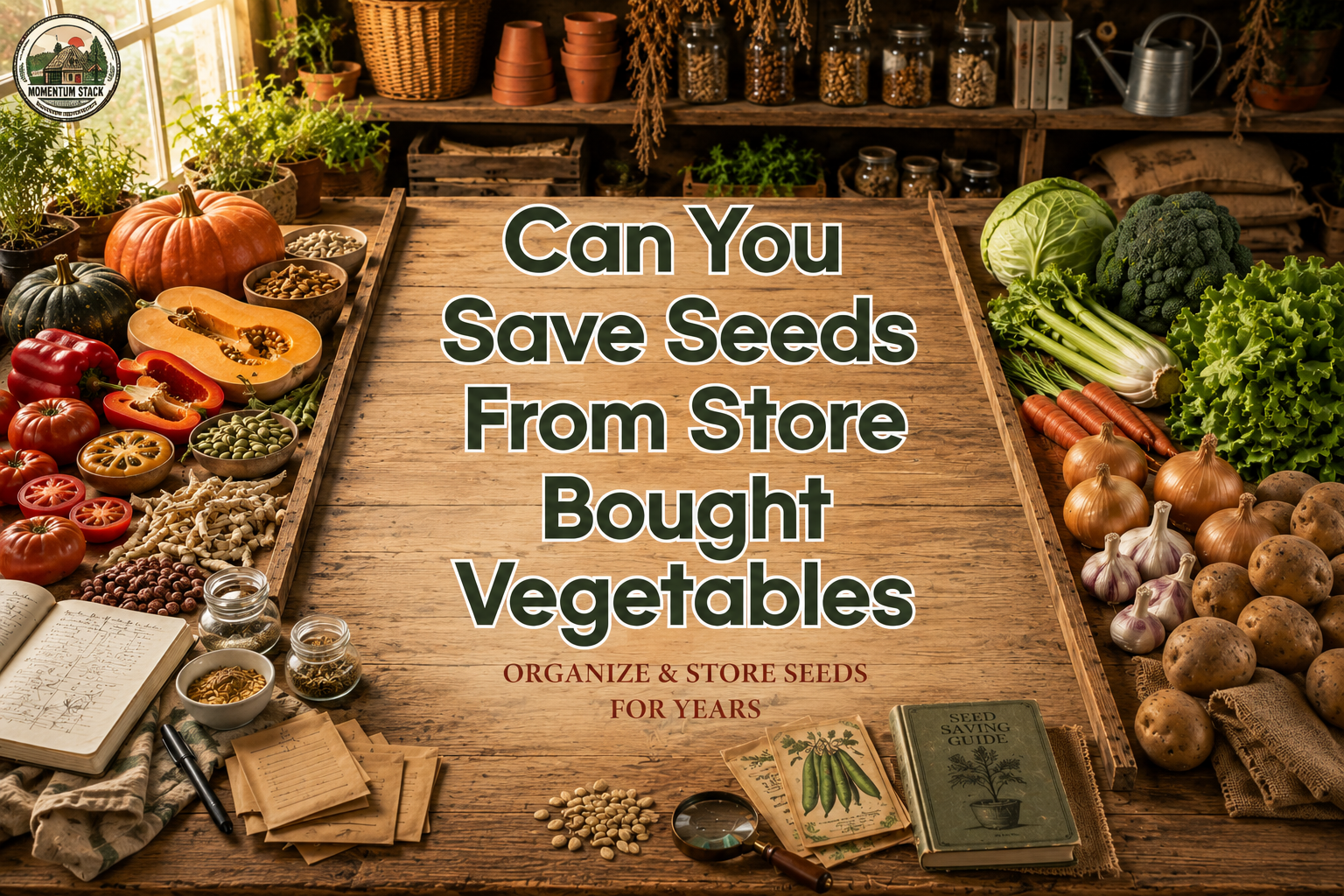

Short answer: Yes, you can often save seeds from store-bought vegetables—but whether those seeds produce healthy, productive plants depends on much more than simply planting them. The variety, how the vegetable was grown, and even when it was harvested all influence your results.
Can You Save Seeds From Store-Bought Vegetables? What Actually Works (and What Doesn’t)
If you’ve ever sliced open a ripe tomato or scooped seeds from a bell pepper, you’ve probably wondered:
“Could I plant these instead of buying seed packets?”
It’s an appealing idea. Saving seeds from vegetables you’ve already purchased costs almost nothing, reduces waste, and can be a fun way to start a garden. For many gardeners and homesteaders, it also feels like an important step toward greater self-reliance.
The good news is that many grocery store vegetables contain perfectly viable seeds. In some cases, those seeds will germinate easily and grow into healthy plants.
The catch is that not every seed will produce the same vegetables you originally bought.
Many commercial vegetables come from hybrid (F1) varieties, which are bred to combine desirable traits such as disease resistance, uniform size, or higher yields. While hybrid seeds are usually capable of germinating, the next generation often produces plants with unpredictable characteristics.
On the other hand, vegetables grown from open-pollinated or heirloom varieties are much more likely to grow true to type, making them excellent candidates for seed saving.
In this guide, you’ll learn:
- Which store-bought vegetables are worth saving seeds from
- Why some seeds grow true while others don’t
- How to recognize likely hybrid vegetables
- Common mistakes that reduce germination
- When buying fresh seed is actually the better choice
Whether you’re building a home seed bank or simply experimenting in your backyard, understanding these differences can save both time and disappointment.
Can You Really Save Seeds From Grocery Store Vegetables?
Yes—but success depends on the vegetable, not just the seed.
Many people assume that if a seed can sprout, it will eventually produce the exact same vegetable they purchased. Unfortunately, gardening doesn’t always work that way.
A seed has to pass several “tests” before it becomes a productive plant.
For example:
- Was the vegetable fully mature before harvest?
- Is the seed still alive and viable?
- Was the plant an open-pollinated variety or a hybrid?
- Has the seed been damaged by improper storage or processing?
Only when these conditions line up are you likely to get reliable results.
Think of grocery store seed saving as a spectrum rather than a simple yes-or-no answer.
| Situation | Likelihood of Success |
|---|---|
| Ripe heirloom tomato | ⭐⭐⭐⭐⭐ Excellent |
| Mature sweet pepper | ⭐⭐⭐⭐ Good |
| Dry beans or peas | ⭐⭐⭐⭐⭐ Excellent |
| Grocery store cucumber | ⭐⭐⭐ Moderate |
| Potatoes from supermarket | ⭐⭐ Variable |
| Carrots or onions | ⭐ Low |
As a general rule:
- Fruiting vegetables (tomatoes, peppers, beans, peas, pumpkins) are often good candidates.
- Root vegetables and leafy crops are usually much less practical for home seed saving because they require a second growing season to produce viable seed.
This doesn’t mean seed saving from grocery produce is impossible—it simply means choosing the right vegetables dramatically improves your chances of success.
What Determines Whether Store-Bought Seeds Will Grow?
Several factors influence whether seeds collected from grocery store vegetables will germinate and produce healthy plants.
1. Seed maturity
Seeds must be fully developed before they can germinate.
Many vegetables sold for eating are harvested before reaching complete seed maturity.
For example:
- Green peppers are harvested early.
- Green beans contain immature seeds.
- Cucumbers are usually picked long before their seeds fully mature.
In contrast:
- Overripe tomatoes
- Fully colored peppers
- Dry beans
- Mature winter squash
often contain seeds that are ready for planting.
The riper the fruit, the greater the chance that its seeds are fully developed.
2. Seed viability
Even mature seeds gradually lose their ability to germinate.
Factors that reduce viability include:
- prolonged storage
- excessive heat
- moisture exposure
- physical damage
- mold
Healthy seeds are typically:
- firm
- plump
- fully formed
- naturally colored for the species
Shriveled, soft, or damaged seeds are much less likely to sprout.
Before storing any seeds long term, it’s worth performing a germination test to avoid keeping seeds that are no longer viable.
Related reading: How to Test Seed Germination Before Planting
3. Hybrid vs. open-pollinated varieties
This is often the single most important factor.
Even if hybrid seeds germinate successfully, they may not produce vegetables that resemble the original fruit.
Plants grown from hybrid seed can vary in:
- fruit size
- flavor
- color
- productivity
- disease resistance
By contrast, open-pollinated varieties are much more likely to produce offspring with consistent characteristics, making them the preferred choice for gardeners who regularly save seeds.
We’ll explore this difference in more detail in the next section.
4. Harvest timing
Commercial growers harvest vegetables at different stages depending on how far they must travel.
Vegetables shipped long distances are frequently picked before reaching full maturity to improve shelf life.
Unfortunately, earlier harvest often means:
- less developed seeds
- lower germination rates
- weaker seedlings
Locally grown produce from farmers’ markets is sometimes harvested later, increasing the chance of obtaining mature, viable seed.
5. Post-harvest handling
After harvest, vegetables may be:
- refrigerated
- washed
- stored for extended periods
- transported long distances
These steps usually don’t kill seeds outright, but they can reduce overall quality over time.
For best results, collect seeds from:
- fresh produce
- fully ripe vegetables
- undamaged fruit
- locally grown produce whenever possible
These simple choices can significantly improve germination success.
Open-Pollinated vs. Hybrid Vegetables: Why It Matters
Many beginners assume that if a seed sprouts, the job is done. In reality, germination is only the first step. What matters just as much is whether the new plant will resemble the vegetable you originally saved the seed from.
This comes down to one key distinction: open-pollinated versus hybrid (F1) varieties.
An open-pollinated (OP) vegetable is pollinated naturally—by insects, wind, or self-pollination—and, when isolated from other compatible varieties, produces seeds that grow true to type. This means the next generation will closely resemble the parent plant in size, flavor, color, and growth habit.
Heirloom varieties are a special category of open-pollinated plants that have been passed down for generations, making them especially popular among seed savers.
Hybrid (F1) vegetables are different. They are created by deliberately crossing two distinct parent lines to combine desirable traits such as:
- Better disease resistance
- Uniform fruit size
- Higher yields
- Improved shipping quality
- Longer shelf life
These advantages make hybrids popular with commercial growers. However, the seeds from hybrid plants often produce a genetically mixed second generation, meaning the plants you grow may vary widely from the vegetable you originally purchased.
| Feature | Open-Pollinated | Hybrid (F1) |
|---|---|---|
| Seeds grow true to type | ✅ Usually | ❌ Often unpredictable |
| Good for long-term seed saving | ✅ Yes | ⚠️ Not ideal |
| Consistent harvest | ✅ High | ⚠️ Variable |
| Common in home gardens | ✅ Very common | ✅ Very common |
| Common in supermarkets | Sometimes | Very common |
This is why two gardeners can both save seeds from grocery store tomatoes and have completely different experiences. One may unknowingly grow an heirloom variety and harvest nearly identical fruit, while the other plants seeds from a hybrid tomato and ends up with smaller, differently shaped, or less flavorful tomatoes.
Understanding this difference helps set realistic expectations—and explains why seed saving is as much about choosing the right variety as it is about collecting the seeds themselves.
Best Store-Bought Vegetables for Saving Seeds
Not all vegetables are equally suitable for seed saving. In general, fruiting vegetables tend to produce mature, viable seeds much more reliably than root or leafy crops.
Here’s a quick overview of some of the best candidates.
| Vegetable | Worth Saving? | Notes |
|---|---|---|
| Tomatoes | ⭐⭐⭐⭐⭐ | Excellent if open-pollinated or heirloom |
| Peppers | ⭐⭐⭐⭐☆ | Works well from fully ripe peppers |
| Dry Beans | ⭐⭐⭐⭐⭐ | One of the easiest crops for beginners |
| Peas | ⭐⭐⭐⭐⭐ | Reliable when pods have fully dried |
| Pumpkins | ⭐⭐⭐⭐☆ | Great if not crossed with other squash |
| Winter Squash | ⭐⭐⭐⭐☆ | Good when mature and open-pollinated |
| Cucumbers | ⭐⭐⭐☆☆ | Possible but often hybrid |
| Melons | ⭐⭐⭐☆☆ | Cross-pollination can affect results |
Let’s look at each one more closely.
Tomatoes
Tomatoes are among the easiest vegetables for beginners.
If the tomato came from an heirloom or open-pollinated variety, the saved seeds often produce plants very similar to the parent.
For the best results:
- Choose fully ripe fruit.
- Ferment the seeds for several days to remove the gel coating.
- Dry thoroughly before storage.
Related guide: Learn How to Save Seeds from Vegetables
Peppers
Peppers also save well, provided they’re completely ripe.
A green bell pepper is simply an immature pepper, so its seeds may not be fully developed.
Instead, collect seeds from:
- red peppers
- yellow peppers
- orange peppers
- fully mature hot peppers
Dry Beans and Peas
Beans and peas are among the simplest vegetables for seed saving because nature has already done most of the drying.
Wait until pods are:
- brown
- dry
- brittle
Then remove the seeds and store them properly.
Pumpkins and Winter Squash
These crops often contain mature seeds with excellent germination potential.
The biggest challenge isn’t viability—it’s cross-pollination.
If nearby squash varieties cross-pollinated during flowering, next year’s fruit may not resemble the original.
Cucumbers
Cucumbers can produce viable seeds, but only when the fruit becomes much more mature than what most grocery stores sell.
A seed-saving cucumber is typically:
- yellow
- oversized
- left on the vine well beyond eating stage
Most supermarket cucumbers are harvested before reaching this point.
Melons
Melon seeds usually germinate well.
However, many commercial melons are hybrids, so fruit quality in the next generation may vary.
Vegetables That Usually Aren’t Worth Saving Seeds From
Some vegetables are technically capable of producing seeds, but they’re poor choices for beginners.
These crops often require:
- two growing seasons
- flowering after winter
- complicated isolation
- controlled pollination
As a result, buying fresh seed is usually more practical.
| Vegetable | Why It Isn’t Ideal |
|---|---|
| Carrots | Biennial crop |
| Onions | Biennial crop |
| Garlic | Usually propagated from cloves |
| Potatoes | Grown from tubers rather than seed |
| Broccoli | Easily cross-pollinates |
| Cabbage | Requires overwintering |
| Cauliflower | Similar challenges |
| Celery | Flowers in second year |
| Store lettuce heads | Rarely mature enough |
Carrots
Carrots don’t produce seeds during their first growing season.
Instead, they must survive winter before flowering the following year.
That makes them impractical for most beginners.
Onions
Like carrots, onions are biennial.
The bulbs you buy for cooking won’t produce harvestable seeds without another full growing cycle.
Potatoes
Although potatoes can produce botanical seeds, gardeners almost always plant seed potatoes or tubers instead.
Growing from true potato seed is a completely different process.
Garlic
Garlic is propagated by planting cloves—not seeds.
Saving cloves is the preferred method.
How to Tell if a Vegetable Is Likely a Hybrid
Unfortunately, grocery stores rarely label vegetables as “hybrid” or “open-pollinated.”
Instead, look for clues.
Possible indicators include:
- Perfectly uniform size
- Identical color
- Commercial packaging
- Mass-produced appearance
- No heirloom variety name
By contrast, farmers’ markets sometimes identify vegetables as:
- heirloom
- open-pollinated
- locally grown
- heritage varieties
These are often better candidates for seed saving.
Remember:
None of these clues are guarantees.
Without knowing the original variety, you can never be completely certain.
Does Organic Mean Better Seeds?
This is one of the biggest misconceptions among new gardeners.
The answer is:
Not necessarily.
Organic certification tells you how the crop was grown, not how it was bred.
That means an organic tomato can still be:
- a hybrid
- open-pollinated
- heirloom
Organic farming and seed genetics are two separate concepts.
Think of it this way:
| Label | What It Means |
|---|---|
| Organic | Growing method |
| Hybrid | Plant breeding |
| Open-pollinated | Stable genetics |
| Heirloom | Historic open-pollinated variety |
An organic heirloom tomato is excellent for seed saving.
An organic hybrid tomato may still produce unpredictable offspring.
Can Seeds From Grocery Store Tomatoes Really Grow?
Yes.
In fact, tomatoes are one of the most successful grocery-store seed-saving experiments.
Many gardeners have successfully grown tomato plants from supermarket fruit.
However, results vary.
Possible outcomes include:
✅ Plants nearly identical to the original.
✅ Slightly different fruit size.
✅ Lower productivity.
✅ Different flavor.
✅ Unexpected colors or shapes.
This variability is normal when growing seeds from hybrid tomatoes.
If your goal is simply to experiment, grocery store tomatoes are an excellent place to start.
If your goal is preserving a favorite variety for years, purchasing open-pollinated seed is a much more reliable investment.
Tips for Better Success
Following a few best practices greatly improves your chances of growing healthy plants.
Choose fully ripe vegetables
Avoid immature produce.
The more mature the fruit, the more likely its seeds are fully developed.
Dry seeds correctly
Seeds should be dried slowly in a cool, well-ventilated location.
Avoid:
- direct sunlight
- high heat
- ovens
- dehydrators
Related guide: How to Dry Seeds Before Storage
Label everything
Always record:
- vegetable
- variety (if known)
- collection date
Future you will appreciate it.
Test germination
Before planting old seeds, perform a simple germination test.
Even healthy-looking seeds lose viability over time.
Related guide: How to Test Seed Germination Before Planting
Store seeds properly
The three biggest enemies of seed longevity are:
- Heat
- Moisture
- Light
Store seeds inside:
- paper envelopes
- airtight containers
- cool, dry locations
Related guide: Build a Home Seed Bank
Final Verdict
So, can you save seeds from store-bought vegetables?
Absolutely—but choose your vegetables wisely.
For beginners, vegetables like tomatoes, peppers, beans, peas, and winter squash offer the best chance of success.
At the same time, it’s important to understand that germination doesn’t guarantee identical harvests. Many supermarket vegetables come from hybrid plants, meaning the next generation may differ in appearance, flavor, or productivity.
If you’re experimenting, learning, or simply enjoying the process, grocery store seed saving is inexpensive and rewarding.
If you’re building a reliable long-term seed collection, however, open-pollinated and heirloom varieties remain the gold standard.
Frequently Asked Questions
Can I plant seeds from supermarket tomatoes?
Yes. Many supermarket tomato seeds will germinate, although hybrid varieties may not produce fruit identical to the original tomato.
Are grocery store pepper seeds viable?
Often, yes—especially if the pepper is fully ripe. Seeds from red, yellow, or orange peppers generally perform better than those from green peppers.
Does organic produce always have better seeds?
No. Organic refers to how the crop was grown, not whether it’s hybrid or open-pollinated.
Why don’t my saved seeds look like the original vegetable?
The original plant was likely a hybrid, so the next generation inherited a different combination of traits.
Should beginners save grocery store seeds?
Yes—as a learning experience. It’s an inexpensive way to practice seed saving and understand plant genetics before investing in a larger home seed bank.
Quick Checklist
✔ Choose fully ripe vegetables
✔ Prefer tomatoes, peppers, beans, peas, or squash
✔ Avoid immature produce
✔ Dry seeds thoroughly before storage
✔ Label every batch
✔ Test germination before planting
✔ Store seeds in cool, dry, dark conditions
✔ Expect variation if the parent plant was a hybrid