
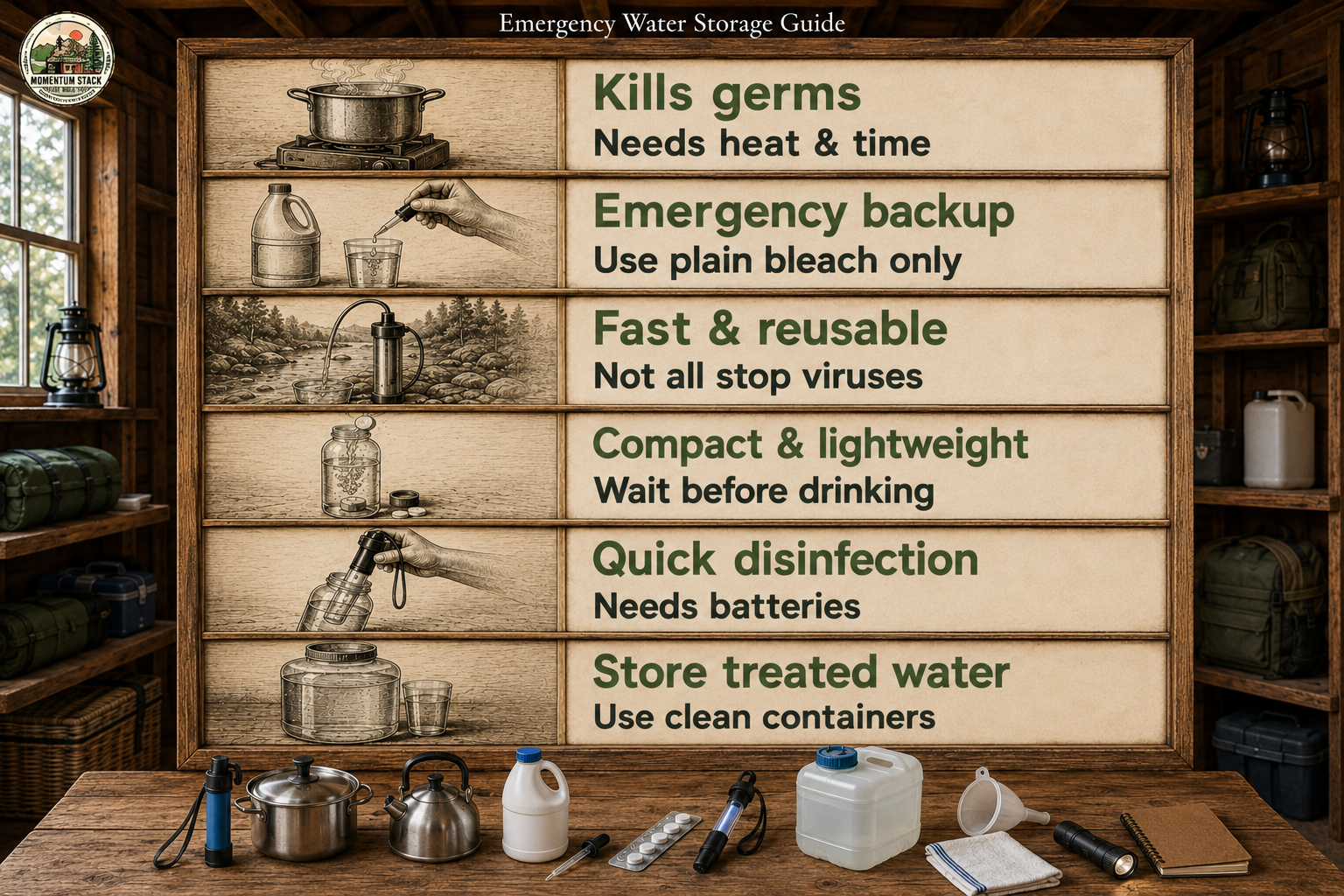

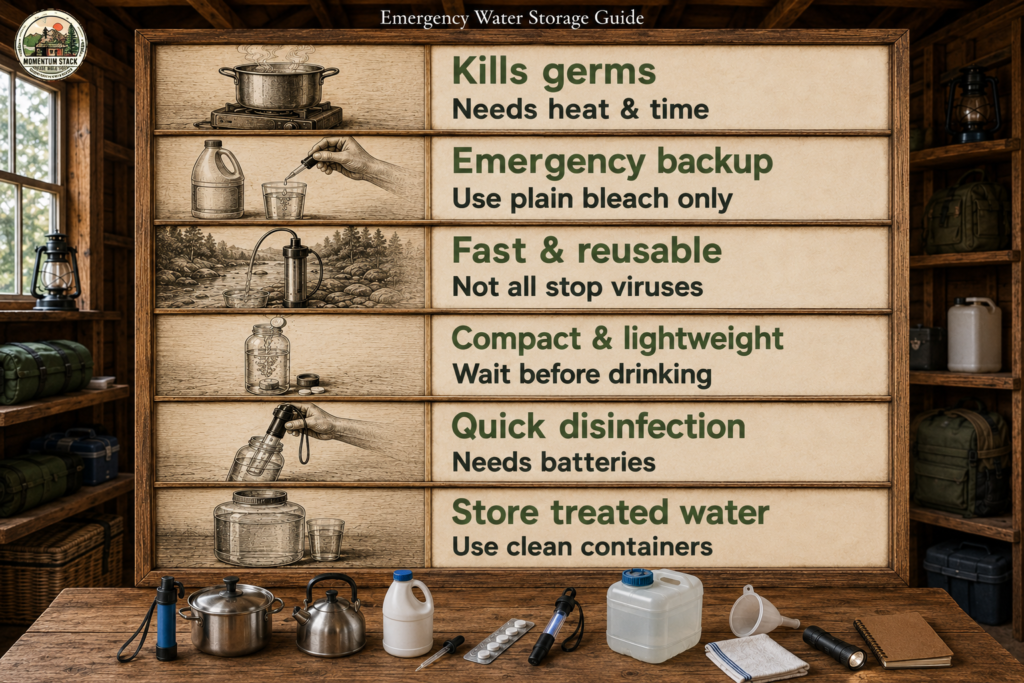
Boiling Water vs Bleach vs Water Filters
When clean tap water is unavailable during a power outage, flood, wildfire, or other emergency, knowing how to make water safe to drink becomes essential. Three of the most common emergency water treatment methods are boiling, household bleach disinfection, and portable water filters. Each method can improve water safety, but they work in very different ways.
One of the biggest mistakes people make is assuming that every purification method solves every problem. In reality, boiling kills harmful microorganisms but doesn’t remove chemicals. Bleach disinfects water but won’t filter out dirt or heavy metals. Water filters can remove sediment and many pathogens, yet not all filters eliminate viruses.
Choosing the wrong method for the situation may leave dangerous contaminants behind or provide a false sense of security.
This guide compares boiling water, bleach, and water filters side by side, explaining:
- How each method works
- What contaminants each method removes
- Their advantages and limitations
- Which option is best for different emergency situations
- When combining multiple methods provides the safest drinking water
By the end of this article, you’ll know exactly which emergency water treatment method fits your situation—and when using more than one method is the smartest choice.
Related: Before treating emergency water, learn the complete process in How to Purify Water During an Emergency. If you’re storing water ahead of time, see How to Store Water Long Term for best practices.
Quick Comparison Table
When time is limited, this table provides a high-level overview of how the three methods compare.
| Feature | Boiling Water | Unscented Bleach | Water Filter |
|---|---|---|---|
| Kills bacteria | ✅ Excellent | ✅ Excellent | ✅ Most filters |
| Kills viruses | ✅ Yes | ✅ Yes | ⚠ Depends on filter |
| Removes protozoa & parasites | ✅ Yes | ✅ Yes | ✅ Most filters |
| Removes dirt & sediment | ❌ No | ❌ No | ✅ Yes |
| Removes chemicals | ❌ No | ❌ No | ⚠ Some carbon filters |
| Removes heavy metals | ❌ No | ❌ No | ⚠ Certain specialized filters |
| Improves taste | ❌ Usually unchanged | ❌ Slight chlorine taste | ✅ Often improves taste |
| Requires electricity | ❌ No (fuel required) | ❌ No | ❌ No |
| Requires fuel | ✅ Yes | ❌ No | ❌ No |
| Works immediately | ❌ Must heat & cool | ❌ Wait about 30 minutes | ✅ Usually immediate |
| Best for | Biological contamination | Emergency disinfection without heat | Daily use, travel, camping, sediment removal |
Key takeaway: No single method is perfect. The safest choice depends on the type of contamination, available supplies, and the emergency you’re facing.
Understanding Different Types of Water Contaminants
Before comparing treatment methods, it’s important to understand what you’re trying to remove. Not all unsafe water contains the same hazards, and different purification methods target different contaminants.
Emergency water can contain four broad categories of contaminants:
Biological Contaminants
These are living organisms that can cause illness.
Examples include:
- Bacteria (E. coli, Salmonella)
- Viruses (Norovirus, Hepatitis A)
- Protozoa (Giardia, Cryptosporidium)
- Parasites
These microorganisms are the primary reason emergency water must be disinfected before drinking.
Sediment and Particles
Floodwater, rivers, ponds, or damaged plumbing often contain:
- Dirt
- Sand
- Rust
- Organic debris
- Mud
While sediment isn’t always dangerous by itself, it can shield microorganisms from disinfectants and reduce the effectiveness of bleach treatment. Filtering cloudy water before disinfection is often recommended.
Chemical Contaminants
Some emergencies introduce pollutants that cannot be removed through simple disinfection.
Examples include:
- Pesticides
- Industrial chemicals
- Fuel and oil
- Cleaning products
- Agricultural runoff
Neither boiling nor bleach can eliminate these contaminants.
Heavy Metals
Water may also contain:
- Lead
- Mercury
- Arsenic
- Cadmium
These require specialized filtration technologies and cannot be removed by simply boiling or adding bleach.
Important: If water is suspected to be contaminated with chemicals or heavy metals, follow local public health guidance. Household boiling or bleach treatment alone will not make chemically contaminated water safe to drink.
How Boiling Water Works
Boiling has been one of the most trusted methods of disinfecting drinking water for centuries because it uses heat to destroy disease-causing microorganisms rather than chemicals or filtration.
When water reaches a rolling boil, the high temperature inactivates bacteria, viruses, and parasites that commonly cause waterborne illness. This makes boiling one of the most reliable emergency treatment methods when fuel is available.
What Boiling Removes
Boiling is highly effective against biological contaminants, including:
- Bacteria
- Viruses
- Giardia
- Cryptosporidium
- Most other disease-causing microorganisms
Because it relies on heat rather than filtration, boiling works regardless of the water’s source—as long as the contamination is biological.
What boiling does NOT remove
Many people mistakenly believe boiling “purifies” water completely.
It does not remove:
- Dirt
- Sand
- Sediment
- Heavy metals
- Salt
- Pesticides
- Industrial chemicals
- Fuel contamination
In fact, because some water evaporates during boiling, certain dissolved contaminants may become slightly more concentrated.
If water appears cloudy, allow particles to settle or filter the water through a clean cloth before boiling.
Advantages of Boiling Water
Boiling remains one of the most dependable emergency purification methods because it:
- Kills nearly all disease-causing microorganisms
- Requires no specialized equipment beyond a heat source and container
- Leaves no chemical residue
- Is recommended by health authorities during many boil water advisories
- Works with water from lakes, rivers, rainwater, or stored emergency supplies (after appropriate pre-filtering if necessary)
Limitations of Boiling Water
Despite its effectiveness, boiling isn’t always practical.
Its main drawbacks include:
- Requires fuel or another heat source
- Takes time to heat and cool
- Doesn’t remove sediment or chemical pollutants
- May be difficult during large-scale disasters when fuel is limited
- Doesn’t improve the appearance of dirty water
For these reasons, boiling is often most effective when combined with pre-filtering or proper emergency water storage practices.
Related: Learn how to keep treated water safe for future use in Water Storage Rotation Schedule and avoid contamination with How to Sanitize Water Storage Containers.
Why Boiling Is Often Considered the Gold Standard
Public health agencies frequently recommend boiling during emergency water advisories because it reliably destroys the widest range of disease-causing microorganisms without relying on specialized equipment or chemical disinfectants.
However, “best” does not always mean “best for every situation.”
The next sections compare boiling with household bleach disinfection and portable water filters to help you choose the right solution when heat, fuel, or clean equipment isn’t available.
How Bleach Disinfects Water
When boiling isn’t possible, unscented household bleach can be an effective emergency disinfectant. Rather than using heat, bleach relies on chlorine to destroy many disease-causing microorganisms found in contaminated water.
For decades, emergency management agencies have recommended bleach as a backup method during disasters because it is inexpensive, widely available, and easy to store in most households.
However, bleach should only be used when you understand both its strengths and its limitations.
How Bleach Makes Water Safer
Bleach works by releasing chlorine into the water.
The chlorine damages the cell structures of bacteria, viruses, and many parasites, preventing them from surviving or reproducing.
Unlike boiling, which uses heat, bleach chemically disinfects water.
When used correctly, it can significantly reduce the risk of waterborne illness.
What Bleach Removes
Bleach is effective against:
- Most bacteria
- Most viruses
- Many disease-causing microorganisms
It is especially useful when treating relatively clear water during emergencies.
What Bleach Does NOT Remove
Bleach does not remove:
- Dirt
- Mud
- Sand
- Rust
- Chemicals
- Heavy metals
- Petroleum contamination
- Bad taste
If water is cloudy, particles may protect microorganisms from chlorine.
Whenever possible:
- Let sediment settle.
- Filter through a clean cloth.
- Then disinfect with bleach.
Advantages of Using Bleach
Bleach offers several practical benefits during emergencies:
- No heat source required
- Easy to store
- Inexpensive
- Lightweight
- Effective for treating larger amounts of water
- Useful during extended power outages
Many emergency preparedness kits include a small bottle of fresh, unscented household bleach specifically for water disinfection.
Limitations of Bleach
Bleach is not a universal solution.
Its effectiveness depends on several factors:
- Correct concentration
- Water temperature
- Water clarity
- Contact time
- Freshness of the bleach
Old bleach gradually loses disinfecting power over time.
Additionally, scented bleach, splashless formulas, color-safe products, or bleach containing additional cleaners should never be used for drinking water.
Best Situations for Bleach
Bleach works well when:
- Fuel is unavailable.
- You need to disinfect stored emergency water.
- Boiling isn’t practical.
- Water is relatively clear.
- You are treating multiple gallons at once.
It is generally less suitable for muddy floodwater unless the water has first been filtered.
How Water Filters Work
Unlike boiling or bleach, water filters do not disinfect by heat or chemicals. Instead, they physically remove contaminants as water passes through specialized filtration media.
Modern emergency water filters range from simple straw filters to gravity-fed systems capable of supplying an entire household.
Because different filters use different technologies, their capabilities vary considerably.
Mechanical Filtration
Most portable emergency filters use microscopic pores that trap contaminants.
Depending on the filter, they may remove:
- Sediment
- Dirt
- Sand
- Rust
- Bacteria
- Protozoa
- Giardia
- Cryptosporidium
This is why backpackers often rely on compact filters when collecting water from streams or lakes.
Carbon Filtration
Some filters include activated carbon.
Carbon improves:
- Taste
- Odor
- Chlorine reduction
- Certain chemicals
However, activated carbon does not remove every chemical contaminant.
Performance depends on the filter’s design and certification.
Virus limitations
This is where many people become confused.
Most portable backpacking filters do not remove viruses because viruses are much smaller than bacteria.
Only filters specifically designed as purifiers or certified for virus removal can reliably eliminate them.
If viral contamination is possible, additional treatment—such as boiling or chemical disinfection—may still be necessary.
Advantages of Water Filters
Emergency water filters offer several benefits:
- Produce clean water quickly
- Improve taste
- Remove sediment
- Require no fuel
- Reusable
- Ideal for camping and bug-out bags
- Excellent for daily preparedness
They are often the most convenient option when traveling or using natural water sources.
Limitations of Water Filters
Despite their convenience, filters also have drawbacks.
They:
- Require maintenance
- Eventually clog
- Need replacement cartridges
- May not remove viruses
- Cannot guarantee removal of all chemical pollutants
Understanding the filter’s specifications is essential before relying on it during an emergency.
Comparison by Emergency Situation
Rather than asking “Which method is best?”, ask:
“Which method is best for this specific situation?”
The answer changes depending on the emergency.
| Emergency Situation | Best Choice | Why |
|---|---|---|
| Power outage | Boiling | Reliable if fuel is available |
| Floodwater | Filter → Boil | Removes debris first, then disinfects |
| Camping | Water filter | Fast and portable |
| Backpacking | Water filter | Lightweight and reusable |
| Boil water advisory | Boiling | Officially recommended in many cases |
| Long-term emergency shelter | Filter + Bleach | Conserves fuel while maintaining safety |
| Stored emergency water | Bleach (if needed) | Easy to disinfect stored supplies |
| Unknown water source | Filter + Boil | Maximum protection |
Notice that the safest answer is often a combination of methods, not a single one.
Which Method Is Best?
There isn’t a universal winner because each method addresses a different problem.
Choose boiling if:
- You suspect biological contamination.
- Fuel is available.
- Public health officials recommend boiling.
- Water is relatively clear.
Choose bleach if:
- Fuel is unavailable.
- You need to disinfect larger quantities.
- You’re treating stored emergency water.
- The water is already relatively clear.
Choose a water filter if:
- You need clean water immediately.
- You’re collecting water outdoors.
- Sediment removal is important.
- You want better taste.
The Best Overall Strategy
For many emergency scenarios:
Filter first → Boil second → Store safely
This combination removes sediment before disinfecting the water, providing broader protection than either method alone.
Can You Combine Methods?
Absolutely.
In fact, combining methods often produces the safest results.
Examples include:
Filter → Boil
Ideal for:
- Rivers
- Lakes
- Floodwater
The filter removes particles while boiling destroys remaining microorganisms.
Filter → Bleach
Useful when fuel is unavailable.
Filtering first allows chlorine to work more effectively.
Boil → Store
Once water has cooled, store it in sanitized food-grade containers with tight-fitting lids to reduce the risk of recontamination.
Filter Only
Appropriate for:
- Hiking
- Backpacking
- Relatively clean mountain streams
Provided your filter is suitable for the expected contaminants.
Common Mistakes
Even with the right equipment, mistakes can reduce water safety.
Avoid these common errors:
Assuming Clear Water Is Safe
Clear water can still contain harmful bacteria and viruses.
Using Scented Bleach
Only plain, unscented household bleach is appropriate for emergency water disinfection.
Forgetting That Filters Have Limits
Not every filter removes viruses or chemicals.
Read the manufacturer’s specifications before relying on one.
Skipping Pre-Filtering
Cloudy water reduces the effectiveness of both boiling and bleach treatment.
Recontaminating Treated Water
Safe water can become unsafe again if stored in dirty containers.
Always sanitize storage containers before filling them.
Related: Learn the correct cleaning process in How to Sanitize Water Storage Containers.
Final Thoughts
Boiling, bleach, and water filters each play an important role in emergency preparedness, but none is a complete solution on its own.
Boiling remains one of the most reliable ways to eliminate disease-causing microorganisms. Bleach provides a practical backup when fuel isn’t available. Water filters excel at removing sediment and improving usability, making them ideal for everyday preparedness and outdoor use.
The safest approach is to match the treatment method to the situation rather than relying on a single technique for every emergency.
By understanding what each method can—and cannot—do, you’ll be better prepared to make safe decisions when access to clean drinking water matters most.
Frequently Asked Questions
Is boiling water better than using bleach?
Boiling is generally considered the most reliable method for destroying bacteria, viruses, and parasites. Bleach is an excellent alternative when heating water isn’t possible but requires proper dosage and contact time.
Can I use both a water filter and boiling?
Yes. Filtering removes sediment and many microorganisms, while boiling destroys any remaining disease-causing pathogens. This combination provides excellent protection for untreated water.
Does boiling remove chemicals?
No. Boiling does not remove heavy metals, pesticides, fuel, or industrial chemicals. Some dissolved contaminants may even become slightly more concentrated as water evaporates.
Do all water filters remove viruses?
No. Many portable backpacking filters remove bacteria and protozoa but not viruses. Check the manufacturer’s certification before relying on a filter for virus protection.
Is bleach safe for drinking water?
When plain, unscented household bleach is used in the correct amount and allowed sufficient contact time, it can safely disinfect drinking water during emergencies.
Which method is best during a flood?
Floodwater often contains both sediment and microorganisms. Filtering first to remove debris, followed by boiling, generally provides the highest level of protection.
Emergency Water Treatment Checklist
✔ Identify the likely source of contamination.
✔ Remove visible sediment if water is cloudy.
✔ Choose the most appropriate treatment method.
✔ Follow recommended treatment procedures carefully.
✔ Allow treated water to cool if boiled.
✔ Store treated water in sanitized food-grade containers.
✔ Label stored water with the treatment date.
✔ Replace emergency water supplies according to your storage plan.
Next Steps: Continue building your emergency water preparedness plan with Best Water Storage Containers for Emergency Preparedness, How Long Does Stored Water Last?, How to Purify Water During an Emergency, and How to Sanitize Water Storage Containers Before Filling Them.